|
|
|
The exhibition "Treasures from the depths of the sea - White gold - Submerged
- Discovered - Recovered," on display presents more than 250 selected
artifacts - out of thousands recovered - including 200 examples of ancient
Chinese porcelain. The artifacts were discovered by Franck Goddio in the wrecks
of five Chinese cargo ships or "junks," which sank between the 11th and 16th
centuries in the Pacific Ocean, near the coast of the Philippines.
Early
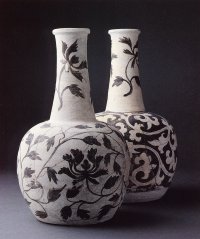
evidence of the Chinese art of porcelain is provided by an array of decorated
jugs, vases, pots, cups, little bowls and plates. These items are also important
cultural/historical attractions, the earliest of which were made centuries
before the manufacture of porcelain in Europe. The Chi-nese artists/craftsmen of
the time created consumer goods of timeless beauty and quality, which still
delight people today.
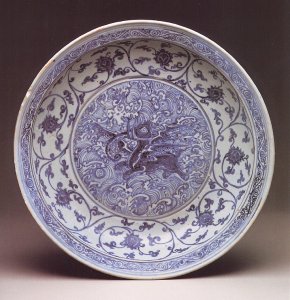
The most remarkable object is the "Flying
Elephant." It depicts an elephant, surrounded by lotus flowers, which is flying
over a storm-lashed sea. The elephant is a symbol of power and strength in
Chinese mythology. This 500-year-old bowl, measuring 40 cm in diameter, was
discovered and recovered - along with 5,000 other artifacts from the "Lena"
junk (see below) in the Philippine Sea. The design and decoration are
un-duplicated in any known examples of Chinese porcelain.
Another
extraordinary find is a jug which contains, hidden under tea leaves, 54 kilos of
bronze bracelets. (The export of metal was forbidden at the time, by a decree of
the Chinese emperor.)
This exhibition of Chinese porcelain is a very
special event for visitors of every age. The presentation includes the chance to
participate in a simu-lated underwater excavation, to get a sense of how the
undersea world looks and feels during the recovery of sunken artifacts.
The porcelain and other items were recovered by French underwater
archaeologist Franck Goddio in co-operation with the European Institute for Underwater Archaeology and the
Philippine National Museum in Manila. With the aid of the Hilti Foundation,
Goddio succeeded in developing a sophisticated technology to help locate and
recover archaeological objects that were otherwise lost to time.
Unlike
on-land excavations, where history is deposited layer by layer (and frequently
mixed), a ship's wreck can offer essential advantages, as it often lies
undisturbed until discovery. Thus, the findings at the bottom of the sea can
bear witness to a precise moment of history.
The five Chinese junks,
from whose recovered cargo the "White Gold" artifacts were chosen, were
excavated between 1985 and 1997. As the original names of the ships are unknown,
the wrecks were named ac-cording to the site of their discovery: the reefs or
small villages along the coast:
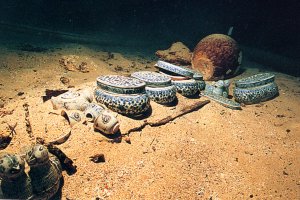
- Breaker junk - sunk at the end of 11th/beginning of 12th century, found in
1991 at a depth of 2.5 meters.
- Investigator junk - sunk at the end of 13th century, found in 1990 at a
depth of 3 to 4 meters.
- Lena junk - sunk at the end of 15th century, found in March 1997 at a depth
of 50 meters.
- San Isidro junk - sunk in the mid-16th century, found in 1995 at a depth of
50 meters.
- Royal Captain junk - sunk at the end of 16th century, found in 1985 at a
depth of 3 meters.
|
|
|

|
|


